

The Discover Portugal blog contains affiliate links. If you make a purchase using one of these links, we may receive compensation at no extra cost to you. See the Disclaimer for more information.
Festas dos Santos Populares in Portugal: June Festival Guide

Visiting Portugal in June? You’re arriving during one of the most festive, smoky, music-filled months of the year: Festas dos Santos Populares.
These popular saints festivals take over towns and cities across Portugal with grilled sardines, street parties, paper decorations, basil plants, parades, and a lot of very late nights.
We live on the edge of Alfama, so Santos Populares is something we experience every June, whether we plan to join in or not. Some years, we wander through the decorated streets earlier in the evening to take photos and enjoy the atmosphere before the crowds build. Other years, we choose a quieter plan because the main nights can be loud, busy, and messy if you’re staying close to the celebration areas.
That’s actually one of the best things about these festivals: you don’t have to experience them only one way. You can squeeze into Lisbon’s Alfama streets for Santo António, celebrate São João in Porto with its riverside fireworks and plastic hammer chaos, or join smaller local parties around the country.
In this guide, we’ll walk you through what Festas dos Santos Populares are, when and where they happen, the Portuguese traditions to look out for, and how to enjoy them as a visitor without feeling completely lost in the crowd.
What to expect as a visitor
Festas dos Santos Populares are not quiet cultural events where you stand back and watch from a distance. They are loud, crowded, smoky (barbecues), and very local, especially in the older neighbourhoods where the street parties take over narrow streets and residential squares.
If it’s your first time, the biggest thing to know is that the atmosphere changes throughout the evening. Earlier in the night, you’ll usually see more families, people having dinner outside, and visitors walking around to see the decorations.
Later on, especially after dinner, the streets get much busier and the celebrations feel more like a huge open-air party. We live on the edge of Alfama, so we usually join the Santos Populares atmosphere earlier in the evening and head home around 9 or 10 PM, before the narrow streets become too packed.
In Lisbon, the most famous areas like Alfama, Bica, Graça, Mouraria, and Bairro Alto can get extremely packed around Santo António. Porto also gets very crowded around the Ribeira and along the Douro during São João.
If you want to experience the festival without feeling stuck in the middle of the biggest crowds, go earlier in the evening or choose a smaller neighbourhood party instead of heading straight to the busiest streets.
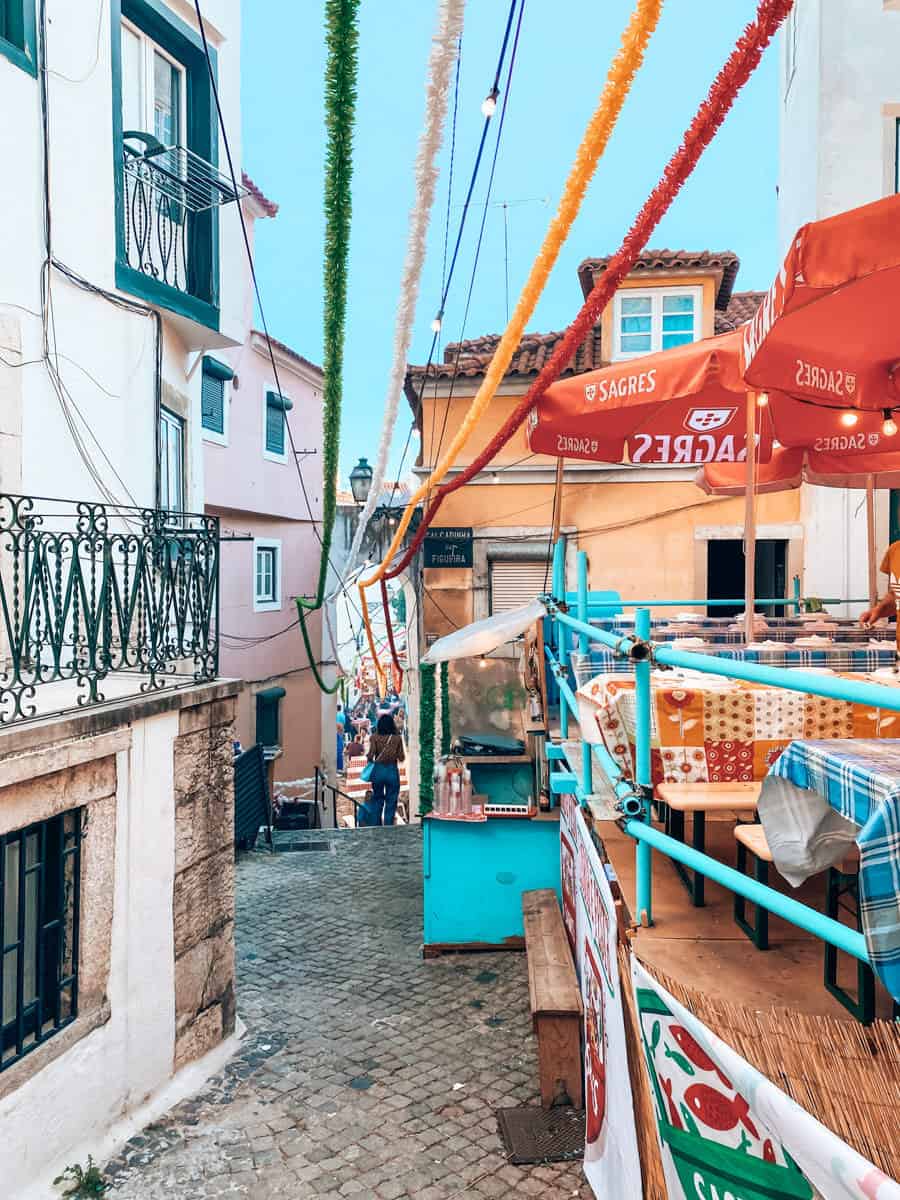
You should also expect a lot of smoke from the grilled sardines, loud pimba music, plastic cups of beer or sangria, paper streamers hanging across the streets, and people dancing wherever there is space. It can feel chaotic if you arrive without knowing what’s happening, but that is also part of what makes Santos Populares so memorable.
Wear comfortable shoes, bring some cash for food and drinks, and don’t plan a very early morning the next day if you want to stay out late. These festivals are some of the best ways to experience Portuguese culture in June.
Not sure where to go in Portugal?
Take the free Portugal travel quiz and find the destination that best matches your travel style. You’ll get your result plus practical tips to help you start planning your trip.
When is Festas dos Santos Populares in 2026?
The main celebrations happen in the evening before each saint’s official day. That means the biggest street parties usually take place at night, while the saint’s day itself is often a public holiday or a quieter day for processions, recovery, and family time.
- June 13th: Saint Anthony’s Day in Lisbon (the day Saint Anthony died). The celebration is on June 12th.
- June 24th: Saint John’s Day in Porto (Festa de São João do Porto). The celebration is on June 23rd.
- June 29th: Saint Peter’s Day in Póvoa de Varzim (Noite de São Pedro). The celebration is on June 28th.
Here are more events for Festas de Lisboa 2026, including parades and other events.
What is Festas dos Santos Populares?
Festas dos Santos Populares is one of the most amazing events in Portugal. It translates to Popular Saints’ Festivals, which happens every June. The celebrations and festivities are for the Popular Saints on the nights of St. Anthony, St. John, and St. Peter.
But these days, it’s more about the parties in the evening than religion. The festival in the capital is known as Festas de Lisboa.
The streets are decorated, the beer flows, and you’ll smell grilled sardines everywhere. Some people even jokingly call it the sardine festival! If you like a good party, Portugal in June it is! You’ll enjoy parades and outdoor events on every street corner. The event is suitable for all ages, and you’ll see many families and children celebrating on the streets.

Things to know about Saint Anthony’s Day in Lisbon
Lisbon is the best place to experience the most famous Santo António atmosphere, but it is also one of the busiest options.
If you want photos, decorations, and a sense of the tradition without committing to party the whole night, go earlier in the evening before the streets become packed, or witness some of the special events.
Popular Marches
On June 12th, you can enjoy a parade (Marchas Populares) on Avenida da Liberdade. The parade is in the evening, usually from 8 PM until 11 PM. The official name of the parade is Marchas dos Bairros, or marches of the neighbourhoods.
Different groups from several areas strive to show the best dances and choreography for a specific theme. The songs are usually about the neighbourhood, the sea, traditions and other traditional topics.
The winners are announced the week before during a performance at Pavilhão Atlântico so that the group can enjoy themselves without stressing during the parade. The Marchas Populares includes more than 20 neighbourhoods, and every performance takes about 15 minutes. Expect big crowds!


Casamentos de Santo António
You can even witness a collective wedding ceremony in Lisbon! Patron Saint Anthony was known to be a bit of a matchmaker! Head over to the Sé Cathedral in Alfama to see this spectacle! During the Casamentos de Santo António (Weddings of St Anthony), sixteen couples will declare their love for each other!
Afterwards, the streets become busier and busier, and you can enjoy cabbage soup (caldo verde), grilled sardines, beer, sangria, or wine. A pimba band will get on stage and ensure you’ll be dancing the night away!
Who was Saint Anthony?
Festa de Santo António is officially celebrated on June 13th, a public holiday in Lisbon, but the city really comes alive the night before. The festival honours Saint Anthony, Lisbon’s beloved patron saint, who was born here in 1195.
Today, the Igreja de Santo António de Lisboa stands near the site traditionally believed to be his birthplace. June 13 marks the day Saint Anthony died in 1231.
A procession runs through the streets of Alfama, and this event has more of a religious aspect. Santo Antonio is the patron saint of Lisbon and the saint of lovers. After the 13th, the Festas de Lisboa festivities will continue every weekend for the remainder of June.
Lisbon in June
Besides Festas de Lisboa, there are many more reasons why you should visit the Portuguese capital in June!
Where are the main areas to celebrate Santos Populares in Lisbon?
As soon as you visit the Alfama, the oldest neighbourhood in the city, you’ll be surrounded by colourful bunting, pimba (upbeat music) and sardines. The narrow streets are bustling, and the place is lively!
Bica, Bairro Alto, Graça, and Mouraria are also popular areas for street parties. Each neighbourhood has its own feel, so you don’t need to stay in one place all night. Pick one or two areas, walk around, and follow the music rather than trying to see everything.
Capture Lisbon during Santos Populares
Lisbon is especially photogenic in June, when streets are covered in colourful paper decorations, basil plants appear outside shops, and neighbourhoods like Alfama, Bica, Graça, and Mouraria feel even more alive than usual.
If you want photos with the Santos Populares atmosphere without fighting the biggest evening crowds, book a Lisbon photoshoot earlier in the day or just before the parties begin. You’ll still get the decorated streets and festive feeling, but with more space to actually enjoy the experience.
📸 Book a colourful Lisbon photoshoot!


Where to stay during Festas de Lisboa?
Are you visiting Lisbon in June and prefer a quiet night’s sleep away from all the noise? It might be best to avoid staying around Ascensor da Bica, Pink Street, Bairro Alto, Rua São Cristóvão in Mouraria, and around Igreja Paroquial de São Miguel in Alfama.
Thankfully, Lisbon has many hotels to choose from! Check availability below and book your dream spot!
Parties around Saint John’s Day in Porto
In Porto, you might be smashed on your head by a plastic hammer! You think what…?!?! The giant plastic hammers are part of the tradition, and bunches of garlic might also be shoved under your nose.
Festa de São João do Porto happens on the night of June 23rd, and the city centre will be jam-packed with people. The traditional fest pays tribute to Saint John the Baptist, but nowadays, São João is more like a street party.
There will be music, dancing, grilled sardines and plenty of booze. Around midnight, you can expect fireworks, colourful hot air balloons or a multimedia show. This is officially the end of São João, but you can celebrate until the sun rises!
Although the big party is on the 23rd, the whole month is already in celebration mode! There are also more events, such as Cascatas de São João. This is a creative contest in which participants create a scene from the lives of São João and Porto. The winning creations are displayed at Bolhão Market the week before the party starts.
Arruada dos Ranchos starts on June 15th. People will listen to rancho, a traditional Portuguese music style. The first concerts will pop up, and dancing on the street will begin! On June 22nd, it’s time for Rusgas de São João, the parade in Porto. Similar to Lisbon, the parade is a contest between neighbourhoods for the best dance, songs, and choreography.


Where are the main areas to celebrate São João in Porto?
Most celebrations start in the afternoon of June 23rd and will continue until the following morning. It’s nice to start with a good meal at one of the fine restaurants in the city. The party usually starts with a traditional dinner before heading out. Afterwards, you can walk towards Cais da Ribeira.
The Ribeira neighbourhood is one of the busiest, and anywhere around the Douro River is lively. Or head over to Vila Nova de Gaia and explore the area of the Ponte Luís I bridge for the activities.
Other neighbourhoods to visit are Miragaia, Fontainhas, and Massarelos Foz do Douro, the place to be after the fireworks. People head over to the river banks to catch the sunset over Porto. And a fresh dip in the sea might avoid that upcoming hangover!
Hotels in Porto
Need to catch up with your sleep? Porto has many great hotels! If you like a good night of rest on the night of the 23rd, maybe avoid the Ribeira neighbourhood for now. But if you’re amongst the partygoers, anywhere in the city centre will be great! Check the map below to locate the best area to stay in.
Celebrations around Saint Peter’s Day in Póvoa de Varzim
Póvoa de Varzim is the place to be on June 28th. Festas de São Pedro are celebrated with bonfires, songs, and dances. It’s the last of the Santos Populares and a late midsummer fest. There is also a parade and competition between the neighbourhoods.
The biggest parties are around the waterfront in Carvalhido and in Largo Caetano de Oliveira, and you can party well until the early hours of June 29th. A procession is also held on June 29th, which includes all three popular saints. Once this is finished, Festas dos Santos Populares is officially over.
Hotels in Póvoa de Varzim
Like Porto and Lisbon, the city is bustling with people during Festas dos Santos Populares. Therefore, booking a hotel or accommodation ahead of time is a must! Book your hotel in time to ensure you have a lovely place to stay!
Popular Saint’s Festival in smaller towns
Smaller Santos Populares celebrations can still be lively, but they often feel easier to navigate than the main nights in Lisbon or Porto. They are a good option if you want to see the tradition in a more local setting.
We’ve also experienced Santos Populares in smaller cities like Évora, where the celebration felt less overwhelming than Lisbon but still filled the streets with music and local festivities.
Lisbon and Porto are the most famous, but smaller celebrations can be a better fit if you want the tradition without the full intensity of the biggest city parties.
Traditions during the Popular Saint’s Festival in Portugal
As you can see, Festas dos Santos Populares is more like a street party than a religious event. But besides the spiritual aspect, many traditions are linked to Festas dos Santos Populares.


Delicious grilled sardines
You’ll smell grilled sardines everywhere you go in June. No escape! The link with Festas dos Santos Populares is so strong that it’s sometimes called the Sardine Festival. You’ll see many barbecues on the street where fresh sardines are grilled.
June is also the start of the sardine fishing season. But the story also goes that Saint Antony practised a sermon by a river when a shoal of sardines stopped swimming to listen to him.
What is the basil plant tradition during Santos Populares?
Have you got a partner? Then it’s a tradition to gift them Majericos, a sweet basil bush, with a poem. The Majerico is like a Valentine herb the man gave to propose to his future wife.
The small bushes often come with colourful paper flowers, and you can find many sellers around Igreja de Santo António de Lisboa. Of course, we gift one to each other each year!
Pimba music
During Festas dos Santos Populares, you’ll hear pimba from every street corner! It’s upbeat music, and we find it very difficult to sit still! The lyrics are pretty silly (sometimes raunchy!), and you might see a lot of laughter from locals during the songs.
Portuguese folk music has some elements, but it’s basically pop music with minimum lyrics. People of all ages will join the dance floor to show their moves! Join in!
Why do people hit each other with plastic hammers in Porto?
The plastic hammer tradition is part of São João in Porto. People gently tap each other on the head with colourful plastic hammers as a playful festival gesture. It can seem strange if you’ve never seen it before, but during São João it’s meant to be fun and friendly, not aggressive.
Not sure where to go in Portugal?
Take the free Portugal travel quiz and find the destination that best matches your travel style. You’ll get your result plus practical tips to help you start planning your trip.
Frequently asked questions
What is Santos Populares in Portugal?
Santos Populares in Portugal is a popular saint festival. The cities have different patron saints, and the dates of the parties depend on the location. The festival lasts the entire month of June, and it’s one of the best times to visit Portugal.
What are the popular saints in Portugal?
Saint Anthony, Saint John and Saint Peter are the most popular saints celebrated in Portugal. In June, there will be many parties to join so you can learn more about this event.
Is Festas dos Santos Populares worth visiting as a tourist?
Yes, Festas dos Santos Populares is worth visiting if you’re in Portugal in June and want to experience a local cultural celebration rather than only sightseeing. The biggest celebrations in Lisbon and Porto can be intense, but you don’t have to stay out all night to enjoy them. Even spending a few hours walking through the decorated streets, listening to music, and trying the traditional food gives you a much better sense of Portuguese summer culture.
Do you need tickets for Festas dos Santos Populares?
Most Santos Populares street parties are free to attend, especially the neighbourhood celebrations, outdoor music, decorations, and general street atmosphere. If there is a specific parade, concert, or dinner you really want to attend, check the local programme before you go.
What do people eat during Festas dos Santos Populares?
Grilled sardines are the most traditional food during Festas dos Santos Populares. They are often served simply with bread, peppers, salad, or boiled potatoes. You’ll also see caldo verde, bifanas, chouriço, beer, wine, and sangria at many street parties. The food is usually casual and part of the street celebration rather than a formal sit-down meal.
What should I wear to Santos Populares?
Wear something comfortable and casual. Santos Populares usually involves standing, walking, and moving through busy streets, so this is not the best night for delicate clothes or uncomfortable footwear. In Lisbon and Porto, many celebrations happen on cobbled streets and hills, so dress for movement rather than for a formal event.
Is Santos Populares family-friendly?
Santos Populares can be family-friendly earlier in the evening, especially before the streets get too crowded. Families often come out for dinner, decorations, parades, and music. Later at night, the biggest celebration areas become much busier, louder, and more adult-focused.
Is Festas dos Santos Populares worth visiting?
Yes, Festas dos Santos Populares is worth experiencing if you’re in Portugal in June and want to see a side of the country that feels more local. These celebrations are not only about the saints themselves, but about neighbourhood identity, summer evenings, food, music, and people gathering outside together.
Lisbon is the best choice if you want the most famous Santo António atmosphere, especially around the historic neighbourhoods and the Marchas Populares. Porto is better if you want one huge city-wide night with fireworks, and São João traditions that feel completely different from Lisbon. Smaller towns and cities can be a better fit if you want something more relaxed and community-focused.
I wouldn’t plan an entire Portugal trip only around Santos Populares unless you love festivals, but if your visit overlaps with one of the main nights, it’s absolutely worth joining for at least a few hours. Even if you don’t stay out all night, it gives you a memorable glimpse into Portuguese culture that you won’t get from museums, viewpoints, or restaurant reservations alone.

Other events in Portugal:
- Cultural Portugal festivals and events you don’t want to miss
- Carnaval Portugal with stunning outfits, parades, and dates
- Carnaval in Torres Vedras
- Celebrate the Carnation Revolution in Portugal on April 25th
- Celebrate Festas dos Santos Populares in Portugal in June
- Visiting the Óbidos Medieval Festival in Portugal in July
- Enjoy the unique Knights Templar Festival in Tomar in July
- Christmas in Lisbon
- Photoshoots in Lisbon during Christmas
- Christmas photography workshops in Lisbon
- Best Christmas markets in Lisbon
- Wonderland Lisboa: the largest Christmas market in Lisbon
- Where to find the most beautiful Lisbon Christmas lights
- Christmas in Óbidos
Pin to read later!


