

The Discover Portugal blog contains affiliate links. If you make a purchase using one of these links, we may receive compensation at no extra cost to you. See the Disclaimer for more information.
Inside Torre de Belém, a UNESCO masterpiece in Lisbon

If you’re visiting Lisbon for the first time and love historic landmarks, Torre de Belém is probably already on your itinerary, but visiting it now takes a little more planning than it used to.
The Belém Tower recently reopened after renovation works, and you now need to prebook a ticket for a specific time slot. That should help with crowd control, but it also means you can’t always just show up and walk in, especially in spring, summer, or around holidays.
I visited tower on a busy spring day, just before closing time, and that timing worked surprisingly well. No more visitors were coming in behind me, so I had a little more space for photos, though the narrow interior staircase still made parts of the visit feel crowded.
Inside, you’ll find Manueline-style details, different levels to climb through, and views over the Tagus River. But this is a small, popular monument, so it helps to know what to expect before you go.
In this guide, I’ll explain how to book tickets, how to get there, what it’s like inside, and the best times to visit Torre de Belém.
Book a photoshoot at the Belém Tower Lisbon!

Perfect for solo travellers, families and couples

Surprise your partner with a proposal in Lisbon!
Not sure where to go in Portugal?
Take the free Portugal travel quiz and find the destination that best matches your travel style. You’ll get your result plus practical tips to help you start planning your trip.
A little bit of history about Torre de Belém
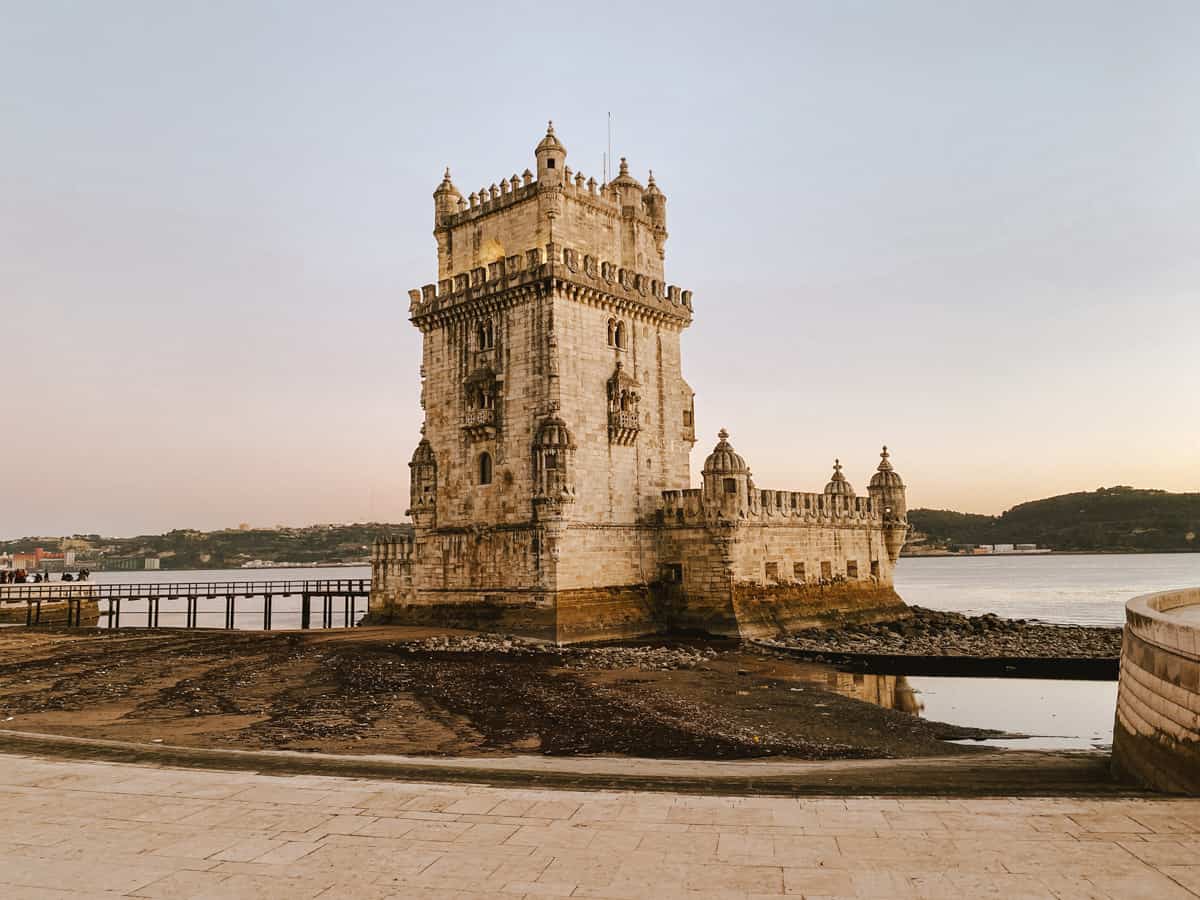
Once upon a time, the tower stood further in the Tagus River. The landmark was built on a small island on the northern bank close to the shore of Restelo. You still need to enter Torre de Belém by footbridge today, as the tower is not connected to the riverbank.


The fortification, the Tower of Santo António and the fortress in Cascais and São Sebastião da Caparica protected Lisbon from the enemy. Lisbon’s port and the surrounding landscape contained several fortresses to stop the enemies coming from the Atlantic Ocean.
Torre de Belém, or the Belém Tower, is one of the most prominent monuments in Belém, Lisbon. The official name is the Tower of Saint Vincent (Torre de São Vicente), named after Lisbon’s patron saint.
It was built in the 16th century on the northern bank of the River Tagus to commemorate Vasco da Gama’s expedition to India in 1497-1498.

The roots of the building are with King John II of Portugal. A ship, the Grande Nau, was used to protect the shores of Belém. The Gothic-style tower then replaced it. This was at the height of the Portuguese territorial power under the reign of King Dom Manuel I. The tower was also built to defend Lisbon from the enemy.

Different uses for the Belém Tower
The Tower of Belém was the first Portuguese fortification with two floors, a milestone for military architecture at that time. The Portuguese fort was upgraded throughout the centuries, the walls strengthened, and the rectangular bastion improved.
The dungeons turned into prisons until 1830, and the tower’s function changed again into a lighthouse and customs house to collect tolls. Between 1780 and 1782, the Fort of Bom Successo was built next to the tower, and the battery was connected. The Bom Sucesso Fortress is nowadays a museum you can visit.

The architecture of Torre de Belém
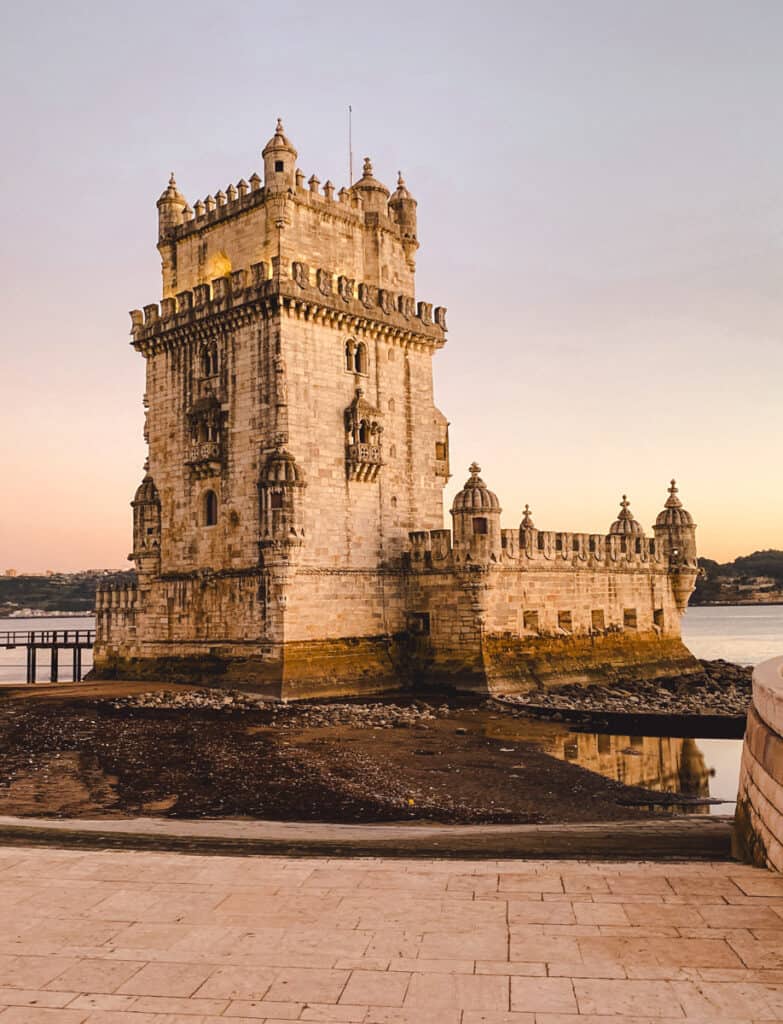
The Belém Tower is a marvellous example of the Portuguese Manueline style. Along with the Jerónimos Monastery further down the road, Torre de Belém has been a UNESCO World Heritage Site since 1983 and a national monument since 1910. The stones used to build the tower and the monastery are the same.
Military architect Francisco de Arruda designed the Belém Tower, and construction started in 1515. The military architect had already designed several fortresses in Morocco, and the Moorish style with arched windows is very recognisable.
In 1521, the tower was finished and ready for use. Belém Tower consists of two parts: the bastion and the 4-storey tower. Today you can visit both parts. Let’s take a closer look!
The bastion of Belém Tower
You can enter the bastion by footbridge and enjoy a stunning view over the Tagus River from the courtyard. The ground floor of the fortress has space for 17 canons. On each corner, you’ll spot a bartizan, an overhanging wall-mounted turret.
The bartizans are decorated with the cross of the Order of Christ, as King Manuel I was a member of the order. From here, you have a fantastic view of the building to soak in the Portuguese architecture and Manueline style.


The bartizans were used as watchtowers, and you still get a fantastic view of the surroundings from inside. The turrets also have images of beasts, such as a rhinoceros.
It’s known as the first sculpture of a rhinoceros in Western European art, and it’s believed to be the one that King Manuel I sent to the pope in 1515.
Inside the Belém Tower
The first floor
The Lisbon Belém Tower consists of four floors and a terrace, and you can see the Belém Tower from the inside. The first floor contains the Governor’s Hall. The Governor’s Hall, or Sala do Governador, is an octagonal room that opens into a cistern.
The northeast and northwest parts are connected to the bartizans. You’ll walk through a small door on the first floor to enter the spiral staircase to the next floor.
The second floor
On the second floor of the rectangular tower, you’ll find a stunning veranda with a loggia. The covered arcade has seven arches with many delicate decorations and ornaments.


On the second floor, you also visit the King’s Hall (Sala dos Reis), which has a beautiful vaulted ceiling and chequered floor. The king could see the ships arrive from the windows, and the fireplace kept everyone warm in winter.
The third floor
On the third floor, you’ll visit the Audience Hall (Sala das Audiências), which has sill windows and arches. The Audience Hall contains a fireplace. You will also see a large relief with the Royal coat of arms.
The first three floors all have ceilings with hollow concrete slabs. The last narrow spiral staircase will take you to the top of the Belém Tower.
The fourth floor
After climbing up the spiral staircase, you’ll enter the Chapel. The Chapel on the fourth floor has ribbed vaulted ceilings and is architecturally the most complex room of all. After seeing this room, you’ll wait in turn to take the same narrow spiral staircase back to the ground floor.


How to get to the Belém Tower
Getting to the Belém Tower is very easy by public transport. Tram 15 leaves from Praça da Figueira and Praça do Comércio to Belém. The tram can get pretty busy, and you might prefer to take the train.
The Cascáis train leaves the station at Cais do Sodré and travels to Belém in about 7 minutes. From the station to the tower is a 20-minute walk, but along the way, you can visit the Popular Art Museum and the monument Padrão dos Descobrimentos.
If you prefer travelling by bus, you can take lines 728, 729, 751, 113, 144, 149, 714 and 727. They all stop near the Belém Tower.
Opening times of the Belém Tower
The Belém Tower is open Tuesdays to Sundays and is closed on Mondays. Visiting hours are between 9.30 AM and 5.30 PM.
The tower is closed on January 1st, Easter Sunday, May 1st, June 13th, and Christmas Day on December 25th.


How to get tickets to Belém Tower
You’ll need a dedicated time slot for the Belém Tower, and it’s highly recommended that you get your ticket beforehand. The entrance fee to the Belém Tower is €15.00, and you can book your time slot here.
Another easy way to enter is with the Lisboa Card. You can enter the tower for free but also have free entrance to the Jerónimos Monastery, you can use public transport for free, and you get many discounts and free entrance tickets to other sights in Lisbon.
Children younger than 11 can enter the monument for free.
Here are your Belém Tower ticket options:
Other things to do in Belém
Don’t leave just yet, and make this neighbourhood a day trip! Aside from the tower, there are many other places to see in this Lisbon district. As mentioned, the Jerónimos Monastery is just across the road and a must-see in Belém.
Afterwards, you can enjoy a tasty Pastel the Belém in the authentic bakery Pastéis de Belém. Did you know its origins trace back to the Jerónimos Monastery? The Tropical Botanical Garden in Belém is fabulous for a quiet moment in nature.


If you’d like to visit a museum, you can see MAAT, the Popular Art Museum, the National Coach Museum, Quake or the Archaeology Museum. The Museum of Contemporary Art – MAC/CCB is fantastic if you love art! Are you travelling with children? They might like to visit the Navy Planetarium!
Hotels in Belém
You might want to stay overnight, with so many things to see in Belém. It is a lovely part of Lisbon, and aside from the tourist attractions, it is a quiet neighbourhood where you can book a hotel.
On the map below, you can see all the accommodations around the Belém Tower. You can book a luxury stay at the NAU Palacio do Governador. They have a swimming pool with sauna and stunning rooms.
The Altis Belém Hotel & Spa is another excellent choice. You’ll have a breathtaking view over the Tagus River, the Ponte 25 de Abril bridge, and the Belém monuments.
Not sure where to go in Portugal?
Take the free Portugal travel quiz and find the destination that best matches your travel style. You’ll get your result plus practical tips to help you start planning your trip.
FAQ
Why is the Belém Tower famous?
The Belém Tower was built to protect Lisbon from enemy ships. Francisco de Arruda designed the Lisbon Belém Tower in the 16th century. Nowadays, it’s a top 10 attraction with a UNESCO landmark status in Lisbon. Belém Tower was the first Portuguese fortification with two floors.
Is the Belém Tower in Lisbon worth visiting?
The famous UNESCO landmark is certainly worth a visit. You will discover multiple floors inside the tower and see the typical Manueline-style architecture. It can be busy, so ensure to book tickets online ahead of time.
How long do I need at Belém Tower?
The time spent at the Belém Tower would take around 1 hour. Book tickets online, so you have a time slot reserved.
How much does it cost to visit Belém Tower?
You can enter Belém Tower for free when you have the Lisboa Card. Otherwise, the price for the tower is €15.00 per person. Children under 11 years of age don’t require a ticket.
Final tips for visiting Belém Tower
Belém Tower is one of the most iconic places to visit in Lisbon, especially if you’re interested in Portugal’s maritime history. Built during the Age of Discoveries, the tower once helped protect the entrance to the city and became an important symbol of the explorers who left from this part of Lisbon.
Inside Torre de Belém, you can see the beautiful Manueline details, visit rooms such as the Audience Hall and the King’s Hall, and climb through the different levels for views over the River Tagus. Just remember that the interior is narrow, so it’s worth booking your time slot in advance and choosing your visit time carefully.
If you have enough time, I definitely recommend spending a full day in Belém. You can combine your visit to Belém Tower with Jerónimos Monastery, Pastéis de Belém, the Monument to the Discoveries, and one of the nearby museums or exhibitions at Centro Cultural de Belém.
After a day of sightseeing, you could also take a boat tour on the river Tagus and enjoy Lisbon from the water, especially around sunset. I hope this guide helps you plan your visit to the Tower of Belém and make the most of your time in this beautiful part of Lisbon.

Other things to see in Belém, Lisbon:
- MAAT Lisbon – Discover the city’s favourite art museum in Belém
- Inside Torre de Belém, a UNESCO masterpiece in Lisbon
- Book your sunset cruise in Lisbon today; an unforgettable experience!
- 22 fantastic things to do in Belém Lisbon
- The National Coach Museum and the Old Royal Riding School in Belém
- Quake Museum Lisbon: A shaky but groundbreaking and fantastic experience!
- Explore Portuguese heritage in the Popular Art Museum in Lisbon
- The Tropical Botanical Garden Lisbon hidden gem in Belém
Pin to read later!


