


The Discover Portugal blog contains affiliate links. If you make a purchase using one of these links, we may receive compensation at no extra cost to you. See the Disclaimer for more information.
Beautiful Queluz National Palace, a hidden gem in Sintra

Do you want to visit Sintra but avoid the crowds? Then, the royal residence of Queluz National Palace should go to the top of your list. When I visited in January, there were only a handful of people there, but it’s much quieter all year than the famous Sintra palaces.
The National Palace and Gardens of Queluz are filled with details, stunning rooms, and a lot of history. It’s easy to reach from Lisbon, and the gardens are beautiful. A visit will take around 2 hours, so let’s take a look at why you should visit Queluz Palace!
What to expect at Queluz National Palace?

A short history of Lisboa Queluz Palace
The National Palace of Queluz, or Palácio Nacional de Queluz, has been a national monument since 1910, but its history goes back to the 17th century. In 1654, Casa do Infantado, including the Queluz Country House, was founded by King João IV, and the buildings were designed by architect Mateus Vicente de Oliveira.
The manor was a large recreational estate at the time. After the restoration of independence in 1640, Casa do Infantado was given to Prince Pedro and the future King Pedro II, as it was created for the second-born sons of the Portuguese monarchs.

Queluz Palace was expanded throughout the years. In 1747, the Old Palace was added. More extensions were added once King Pedro III married Queen Maria I in 1760. Slowly, the National Palace Queluz became a place of leisure and recreation for the Royal Family. Reception halls, such as the Throne Room and the Ambassadors Room, were built at this time.
Queluz Palace became the permanent official residence of the royal family and the Prince Regent in 1794. However, during the Napoleonic invasion of 1807, the royal family fled to Brazil, leaving the palace unattended.

King João VI returned to Portugal in 1821, but the Palace of Queluz never returned to its former glory. King Pedro IV of Portugal was the last to take royal residence in the Palace of Queluz. He passed away from illness in the Don Quixote Room, the same room where he was born. In 1934, a serious fire destroyed one-third of the interior. After extensive renovations, National Palace Queluz is also open to the public and is still a hidden gem in Sintra!
In the 20th century, the eastern wing (the Queen Maria Pavilion) of the palace was used for functions by heads of state making official visits to Portugal. The Portuguese Equestrian Art settled in Queluz Gardens in 1979. Since 2012, Palácio de Queluz is part of Parques de Sintra. Palácio de Queluz is often called the Portuguese Versailles and is well worth visiting!
What to see at the Palace of Queluz?
The Queluz National Palace interior is more than beautiful, and you’ll get to see many different public rooms and private apartments. You will also discover the largest collection of sculptures by John Cheere outside of England.
The Throne Room
Once you enter the building, the first room you visit is the mesmerising Throne Room. It’s the largest reception hall at Queluz Palace. It is richly decorated with gilded wood in the Regency-Rococo architecture style.

This room was built around 1770, and the large Atlases were designed by sculptor-carver Silvestre Faria Lobo. The many mirrors and sparkling chandeliers complete the look!

At the time of King Pedro III and Queen Maria I, it was often used for receptions, and later, it became the Canopy or Throne Room. If there was not enough space in the chapel, it would also be used for royal baptisms.
The Music Room
The Throne Room is adjacent to the Music Room, which is richly decorated with carved wood. This room has not undergone many changes, and it was used for serenades on royal birthdays and other festivities.

In the 18th century, Queen Carlota Joaquina used this room for audiences and hand-kissing ceremonies. Another highlight is the very rare Clementi piano.
Room of the Skylight
Next up is the Lantern Room, once known as the Dark Room. This Room of the Skylight leads to the chapel. At the time of Napoleon, General Junot ordered a skylight opening. The portrait on the wall is of King Miguel I.

The Chapel
Unfortunately, the royal chapel was closed during our visit, as it is undergoing conservation and restoration. After 100 years, the 18th-century pipe organ will be moved back to its original spot, and other areas will be retired. The chapel has been open again since Q1 of 2024.
Mateus Vicente de Oliveira designed the chapel in 1752, and this area is one of the oldest in Queluz National Palace. The paintings in this room are beautiful, and the gilded wood was made by carver Silvestre Faria Lobo.
Chambers of Princess Maria Francisca Benedita
The next part of Queluz Palace contains the private rooms of Princess Maria Francisca Benedita. She was the youngest sister of Queen Maria I. When she married her nephew José, she received the title Princess of Brazil. But he died early, and she became known as Princess Widow.

You will see private apartments in the chambers, such as the Queen’s Boudoir, which is decorated with Pompeian themes. One bedroom was decorated in the Dona Maria style, and another in the French Empire Style.
Smoking and dining
The Smoking Room was used for smoking after dinner and for board games. It’s next to the Dining Room, where you can see a set table displayed. On special occasions, a decor table was set up for fruits and sweets.

Many historical items are displayed in the vitrines of Palácio de Queluz. From here, you will continue the route to the Passage Room and the Corner Room. The Tiled Corridor is also known as the Corridor of Sleeves, and the tiles depict the seasons of the year, continents, and mythology.

Ambassador’s Room
After the Torch Room, the Archer’s Room and the Private Room, you enter the beautiful Ambassador’s Room. Sala dos Embaixadores was built between 1754 and 1762 and was previously known as the Room of Columns and the Room of Serenades. Many concerts were staged here for King Pedro III and Queen Maria I.

There are two thrones on either side of the room. King João VI used the Ambassador’s Room for his audiences and hand-kissing ceremonies. Thanks to the large Chinese porcelain vases, the room is also known as the Room of Carving.

Waiting, dispatch and picnic rooms
The Dispatch Room, decorated in a neoclassical style, was used by Prince Dom Joāo for dispatches. Next door, you will find the Ladies’ Waiting Room. It was here that they would await their next orders. You will see a beautifully set table in the Picnic Room with a honeycomb ceiling.
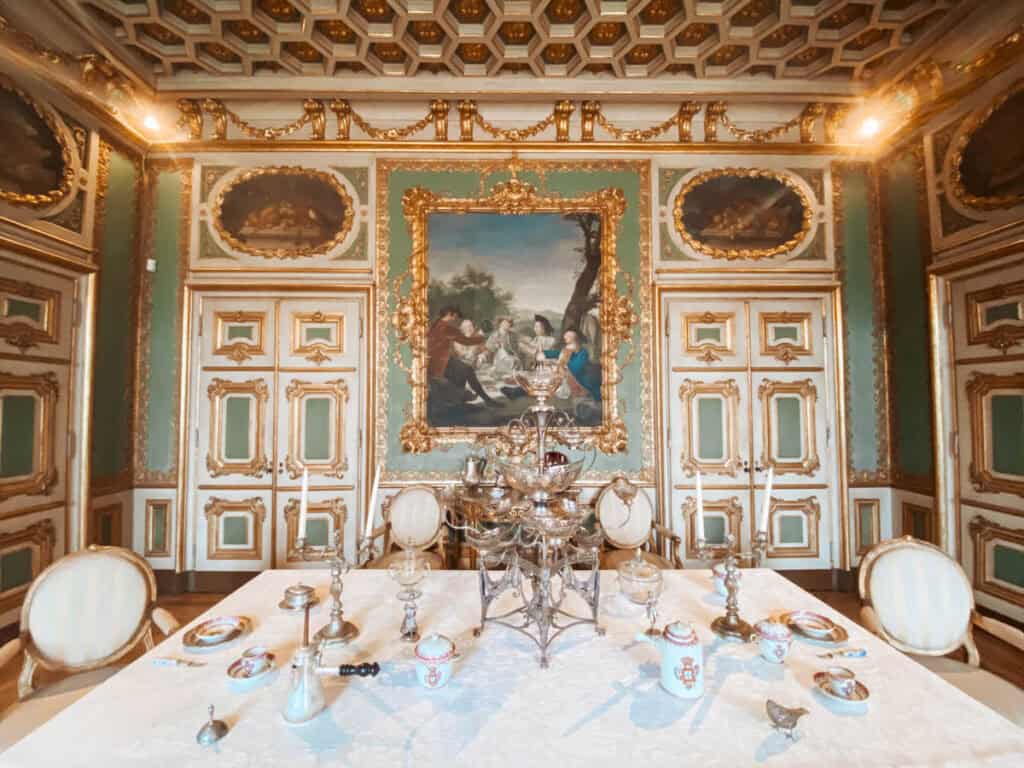
Don Quixote Room
The Don Quixote Room is named after the paintings depicting the life of Don Quixote de La Mancha. Seven of the nine children of João VI and Carlota Joaquina, including Prince Pedro, were born in this room. Prince Pedro, the first Emperor of Brazil, also died in the Don Quixote Room. The King’s Bedroom is one of the most beautiful at the National Palace of Queluz, Portugal!

Carlota Joaquina Rooms
The last section of the Palace of Queluz contains the rooms of Carlota Joaquina. You will see her bedroom with silver paper maché decorations. The Queen’s Dressing Room contains paper maché decorations on the ceiling.


The gardens of Queluz
Next up are the Queluz Gardens. The palace gardens were designed by French architect and silversmith Jean Baptiste Robillion, and there are two upper gardens. The smaller Malta Garden is in front of the Throne and Music Rooms. The Hanging or Neptune Garden next to it contains flowerbeds, lakes, vases and marble statues. It is the largest collection of sculptures by English sculptor John Cheere.


The Grand Cascade is a beautiful Rococo structure, and the water came from a large upper reservoir. The Tiled Canal connects the north and south gardens, and the Jamor River is 115 metres long. There was once a Lake House here, and musicians would play at the pavilion.

The Botanical Garden at Queluz Palace was built between 1769 and 1780, and the greenhouses were used for planting fruits. In the eastern part of the garden, you also have a good view of the Robillion Pavilion. The Pavillion contains the Dispatch Room, Don Quixote Room, the Queen’s Room and many more.

Queluz National Palace tickets
The ticket price for adults is € 13,00 per person. Children under 6 can enter for free, and for youths aged 6 to 17, the entrance price is € 10,00. A family ticket costs € 35,00.
There is an option to add an audio guide to your ticket for € 1.09 with the CloudGuide App. Buy your tickets below to enjoy this magical place!
🎟️ Book your tickets online to save time!
Palace of Queluz opening hours
The National Palace of Queluz is open daily from 9 AM to 6 PM, with the last admission at 5:30 PM.
The Queluz gardens are open from 9 AM until 6.30 PM. The ticket office is closed between 12 PM and 1 PM. You can purchase tickets online or at the vending machine at the entrance.
How do you reach the National Palace of Queluz?
Queluz is easy to reach from Lisbon and Sintra. If you travel from Lisbon to Queluz Palace, you can take the Sintra Line from Oriente, Rossio, or Entrecampos station and exit at Queluz-Belas train station or Monte Abraão station. It’s a one-kilometre walk from the train station, but there is also a bus.
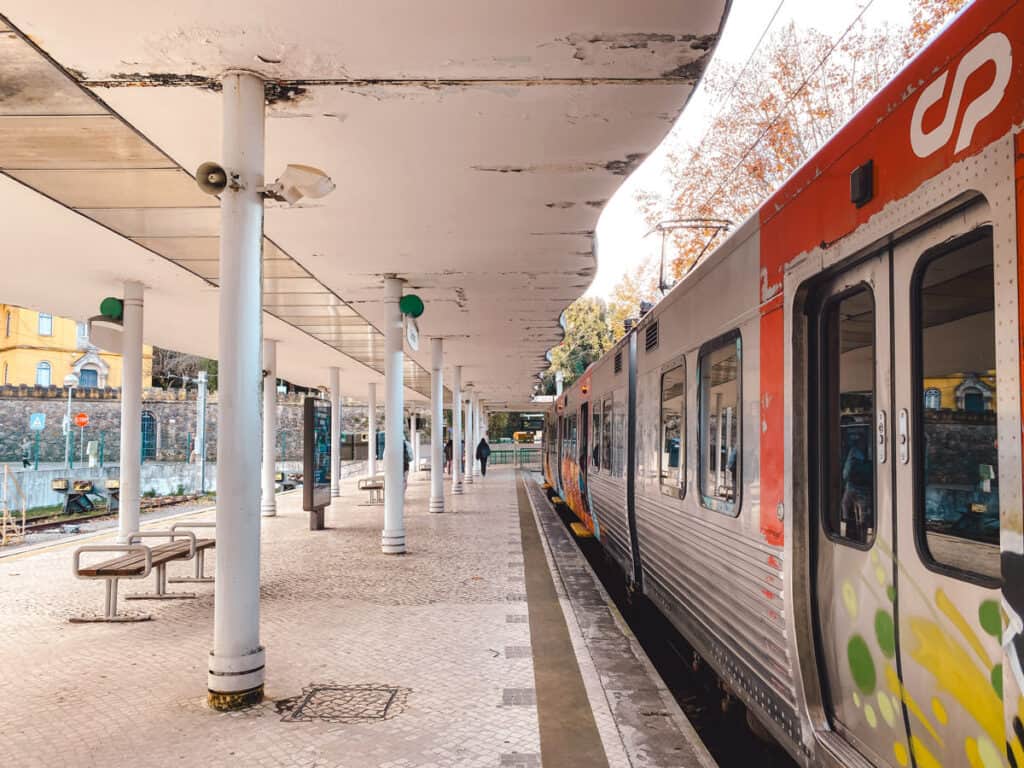
From Sintra, you can take the Sintra Line towards Lisbon and exit at Queluz-Belas station or Monte Abraão station.
If you come by car, you can take the IC19 until exit Queluz-Palácio. There is a car park in front of the palace.
FAQ
Who lived in Queluz Palace?
After a fire at Ajuda Palace in 1794, the National Palace of Queluz became the official residence of the Portuguese prince regent, the future King João VI and other royal family members. King Pedro III and Queen Maria I also lived here.
How do I get to Queluz?
Take the Sintra Line from Lisbon or Sintra, and exit at Queluz-Belas station or Monte Abraão station. From there, you can walk 1 kilometre, or take a bus. There is also a car park nearby, and if you arrive by car, you must take the Queluz-Palácio exit on the IC19.
Conclusion
Visiting the National Palace of Queluz is perfect for seeing a Sintra palace, except for the crowds. The former royal palace contains beautiful rooms with furnishings and art from the royal collections. Queluz was a summer retreat at first but became a permanent residence later.
The royal palace was inhabited by King Pedro III, King Pedro IV, Queen Maria I, and many more members of the Portuguese royal family. The palace slowly fell out of favour with the Portuguese sovereigns, and a fire in 1934 caused extensive damage. Thankfully, the National Palace of Queluz was extensively restored and is now open to the public.

More things to do in Sintra
- How to get to Palácio da Pena in Sintra
- Quinta da Regaleira in Sintra, a guide to visit this magical UNESCO site
- Complete Guide to Park and Palace of Monserrate Sintra
- Sintra day trips from Lisbon; discover the best excursions
- The hidden gem in Sintra; Discover the ancient Convent of the Capuchos
- Beautiful Cabo da Roca Portugal; most westernmost point of Europe
- Biester Palace, a beautiful hidden gem in Sintra
- Sintra National Palace: Discover the beautiful palace close to Lisbon
- Lisbon Sintra by train Travel Guide + 8 top sights to visit
- Discover the picturesque coastal town Azenhas do Mar near Sintra
- Visit the beautiful Castle of the Moors (Castelo dos Mouros) in Sintra
- 8 irresistible beaches in Sintra to visit during your holiday
- How to get to stunning Praia da Ursa
- Beautiful Queluz National Palace, a hidden gem in Sintra
Pin to read later!


