

The Discover Portugal blog contains affiliate links. If you make a purchase using one of these links, we may receive compensation at no extra cost to you. See the Disclaimer for more information.
Incredible views and things to see at Castelo de São Jorge!

If you’re looking for the best view of Lisbon, add a visit to Lisbon Castle to your bucket list! Castelo de São Jorge has a rich history, and the complex houses several things to discover. There is the castle, ancillary buildings, a museum, an archaeological site, and towers you can climb.
Lisbon Castle is a fun highlight for all ages, and you get to immerse yourself in Portugal’s history! São Jorge Castle sits high on one of the city’s seven hills, offering some of the city’s best views. I’m often near the castle and do many photoshoots in the surrounding area, which is just as nice!
There are also many peacocks, and you can hear them from afar! Arrive early to avoid long lines, and be sure to make your reservations online. The Castle of São Jorge is free to visit with the Lisboa Card. In this post, I will give you more tips about what to see and how to prepare for your visit!
An overview of what to expect at Castelo de São Jorge
The history of Castelo de São Jorge
Castelo de São Jorge is believed to have been built during the Islamic occupation in the 10th century. Previous human occupation has also been identified, and the castle holds an incredible history. Little is known about the Iron Age and the Roman period.
During the Moorish occupation, you could find the Medina within the castle walls, but the castle we see today is a remnant of the period following the reconquest of Lisboa.

Moorish rule ended in 1147 when Afonso Henriques and his knights freed the city. With that, Dom Afonso Henriques became the first King of Portugal. Legend states that the knight Martim Moniz prevented the Moors from closing the castle doors. He did this by throwing his body in the doors so the Christian soldiers could enter the castle. Lisbon then became the capital of the Kingdom of Portugal.

The Kings of Portugal, such as King Afonso I, King Afonso III, and King Denis, made many changes throughout the years. The Moorish Alcáçova, for example, was transformed into the Royal Palace of the Alcáçova.
Parts were destroyed, like the city gate at Torre de São Lourenço, located at the point where the western and southern walls meet. Praça Nova (New Square) was added later by King Ferdinand. The wall protecting this area is the Fernandine Wall (Cerca Fernandina).

The structure was severely damaged during the 1755 earthquake. The military barracks were removed around 1940, and the medieval castle as we see it today got a complete makeover. Parts of the old city walls are still visible outside the castle and in other parts of Alfama.
The cult of Saint George
As the name reveals, the castle was dedicated to Saint George in the mid-17th century, but the cult is way older! It is believed crusaders from Northern Europe brought the cult to Lisbon in the 12th century. They conquered the city in 1147, and even the first church built after that was dedicated to Saint George.
Unfortunately, this church is no longer there. Thanks to the Battle of Aljubarrota, he became the patron saint of the new kingdom. From 1821 onwards, the brotherhood moved to the Santa Cruz do Castelo church next to the castle.

What can you see at Lisbon São Jorge Castle?
The castle is one of the most famous landmarks in the city, and the views are one of the highlights. The Observatory Tower offers an incredible 360° view over Lisbon and the Tagus River. But there is more to discover. Let’s have detailed views of what to expect during your visit.

1. The squares
You’ll arrive at a big square as soon as you scan your ticket. It’s called the Place of Arms and was added to enlarge the citadel. The views from the Place of Arms are incredible! The other square, Praça Nova, is closer to the exit. There is a small pine forest next to the archaeological area.


2. The Garden and former palace
In the middle of the monument, you’ll find the remains of the Royal Palace. The palace was once connected with the southwest corner of the castle, and you can still see some of these remains. It was called the Palace of Senhor Afonso. Therefore, it is believed King Afonso III was responsible for the palace.

Other monarchs, such as King Manuel I, made modifications, but what it looked like in detail is still being determined. In 1505, King Manuel I moved the royal residence to another location in Lisbon. The building was then used for military purposes.

In the 1940s, a garden was added to Saint George Castle. It’s a gorgeous green area with native trees from the Portuguese forests. Around the castle walls, you’ll spot oak trees, olive trees, and a variety of fruit trees.
The Royal Palace was heavily damaged during the 1755 earthquake, but many buildings remain. It now houses the cafe and Casa do Leão Restaurant. From the gardens, you have a fantastic view of the city.


Special visitors
The trees also house a unique animal! The gardens are packed with peacocks that show their beautiful colours occasionally. Are you at São Jorge Castle during the sunset? They’ll make a ton of noise in the high trees before going to bed, and it’s spectacular to watch and listen to.


3. Inside the castle
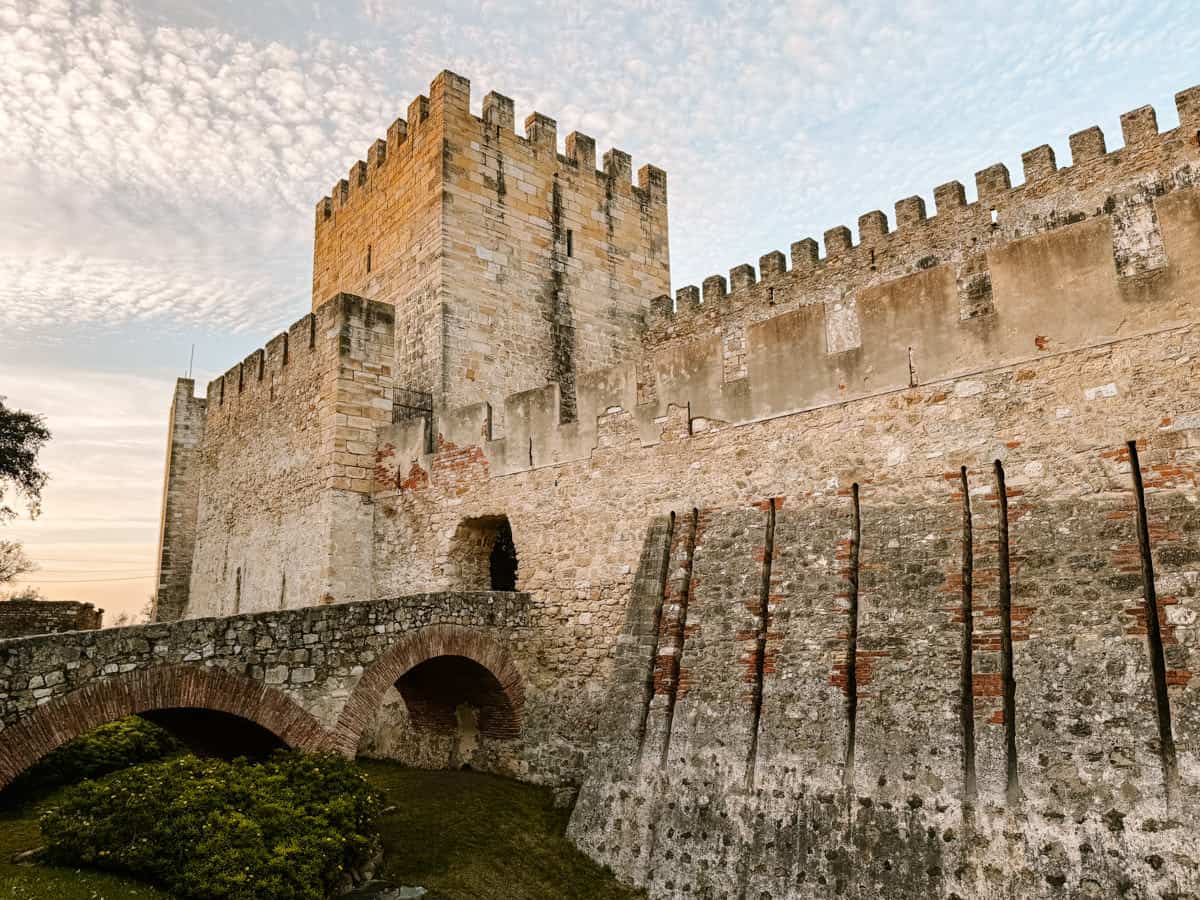
Make your way to the castle’s main gateway underneath Torre de Ulisses, the Tower of Ulysses. The castle is located in the complex’s northwest corner, and you’ll reach it by crossing the stone bridge. The gate leads you to the pátio de armas, the courtyard of arms.


From there, you can climb up to the walkway around the walls. The castle has a quadrangular layout with ten towers to the exterior wall and one tower in the middle of the two patios. You can climb on top of several towers for the breathtaking city views! The castle was the citadel’s last stronghold, located on the highest point of the complex.


4. Camera Obscura
You can visit the Black Chamber at set times. Here, you’ll find a camera obscura, an optical system that shows you a detailed 360º view of Lisbon. The system uses mirrors and lenses to create a view in real time. The camera obscure is open between 10 AM and 5:20 PM and is located at Torre de Ulisses.

5. The towers
The wall is fortified by 11 towers with three entrance gates. The Main Gate has a stone bridge, and the East Gate has a metal bridge. The last entrance is the Gate of Betrayal, a hidden gateway. You’ll see the Barbican on the southern and eastern sides, a low wall to help protect the main castle walls.

The south side has larger towers, and the towers on the northern wall probably contained roofs. The Tower of Ulysses is the biggest tower. Torre Albarrã was also known as Torre do Haver, Torre do Tesouro, and Torre do Tombo, depending on its roles during the centuries. The Observatory Tower is the highest tower and is believed to have been the keep.

It’s believed the Cistern Tower was added later, probably after 1650. The palace tower was located on the complex’s southwest corner but was destroyed during the earthquake. The Albarrana towers were connected by a stone bridge and were considered the most vulnerable. Remember to climb these towers for magnificent views over the entire city!


6. The archaeological site
On the castle grounds, you’ll also discover some incredible ancient treasures. The oldest remains are from the time of the Phoenicians, and within the castle complex, you can visit the remnants of the Iron Age. Archaeologists have found many gems, such as pots and cups, over the years.

The archaeological ruins at São Jorge Castle are restricted and can only be visited by a tour guide. The oldest settlements date from the Iron Age between the 7th and 3rd centuries B.C. The other remnants are of the Moorish era from the mid-11th century. The houses that once stood here were 160m2 and 190m2 and had spectacular geometric designs.
7. Museum Centre
Inside the Museum Centre, you’ll discover the remnants of the Royal Palace of the Citadel. The residence was destroyed during the 1755 earthquake, but some objects survived. You can also visit three rooms with archaeological treasures: the Ogival Room, the Room of Columns, and the Cistern Room. Each displays different archaeological objects.

How to get to São Jorge Castle in Lisbon
Saint Jorge Castle is visible from nearly everywhere you stand in the Portuguese capital city! It is one of the most famous sights in Lisbon, and visiting the castle is highly recommended. It sits high on one of the seven hills, and bus 737 can bring you to the top. That saves a lot of walking!
You can also take a regular taxi to the Arco do Castelo. Please note that Uber and Bolt do not have licenses to drive in these narrow streets and will drop you off 5 minutes walking from the site.

Castelo de São Jorge is located in the heart of Alfama, and it’s a pretty steep walk up from downtown Lisbon. Thankfully, the city has many elevators and escalators, and you can walk up to Saint Jorge Castle without too much effort. With the help of Elevador do Castelo and Elevador da Baixa, you’ll be up the hill in no time!

The official address is Rua de Santa Cruz do Castelo. You’ll reach the castle by entering St. George’s Gate, which consists of a round arch decorated with marble. This is the main entrance to the castle.
Opening hours of Saint Jorge Castle
The best time to visit Castelo de São Jorge in peak season is later in the day. It’s less warm and less busy, and you can enjoy an unbelievable sunset from one of the viewpoints. Early in the morning is also good as the queue is much shorter.


The castle is open seven days a week (apart from January 1st, May 1st, and December 24th and 25th) from 9 AM until 9 PM in the summer (the last entrance is at 8.30 PM). Between November and February, it closes at 6 PM (the last entrance at 5.30 PM). When you visit in winter, it’s less busy during the day.
Tickets for São Jorge Castle Lisbon
You can buy your adult ticket for €17.00 at the ticket office. Children between 13 and 25 pay only €8.50 to enter the castle grounds. People over 65 and people with disabilities receive a reduced rate of €14 and €12 respectively. Children under 12 can enter for free!
There are also ticket machines in the ticket office. Do you want to skip the queue? You can buy your tickets online to save time. These tickets include an audio or tour guide to learn more about the castle.
🎟️ Did you buy the Lisboa Card? You can visit Lisbon Castle for free, with a dedicated skip the line area!
The surroundings of the castle
Not only will you enjoy the beauty of the walls inside, but there is plenty to see in the surrounding streets! This area is freely accessible and has lovely places to eat and stay.

You can enter the main gate to the castle (Arco do Castelo) free of charge and look around the quiet streets around the church Igreja Paroquial de Santa Cruz do Castelo. I do many photoshoots in Lisbon in this residential area, which is so picturesque!
Discover the rest of Alfama
Alfama’s neighbourhood is another must-see location. You’ll discover sights like the Sé de Lisboa, Miradouro da Santa Luzia, the Pantheon and São Vincente de Fora here. On a rainy day in Lisbon, you can visit the Fado Museum and enjoy a Fado show afterwards. Or look in the Azulejo Museum, just a 30-minute walk away and discover the stunning tiles.
Hotels around the castle
Around the castle are some mesmerising hotels and apartments where you can stay. Now that’s an accommodation in style! Some recommendations are Dalma Old Town Suites, Solar do Castelo, and Apartments Center Castelo de São Jorge.
For all other accommodations in Alfama, please refer to the map below.
FAQ
Is São Jorge Castle worth visiting?
Yes! You can enjoy some of the best views over Lisbon from São Jorge Castle! Come on a clear day during sunset, and you’ll have the best time at this famous landmark. The castle complex is excellent for all ages, and many peacocks live in the gardens. And the many viewpoints alone are worth it!
Is Lisbon Castle free?
No, you have to pay an entrance fee to enter Lisbon Castle. Adults pay €17.00 per person, children between 13 and 25 pay €8.50, and children under 12 years are free of charge. Entrance to São Jorge Castle is also included with the Lisboa Card.
How do I get to Lisbon Castle?
The easiest way to get to Lisbon Castle is by bus. Bus line 737 drops you to the top of Alfama Hill at Arco do Castelo. A regular taxi can drop you off at the exact location. It’s a car-free zone, and Uber and Bolt taxis do not have licenses to drive to the entrance. You can also walk, and there are many things to see, but you will walk uphill a lot.
What is the name of the castle in Lisbon?
The castle in Lisbon is called Castelo de São Jorge, also known as Saint George Castle.
Conclusion
Lisbon Castle is known for its unparalleled views over the city. It is one of the Portuguese capital’s most popular attractions and iconic symbols. The castle has a rich history that dates back to the Moorish period. From the main square, you can enjoy panoramic views of Lisboa.
The castle was severely damaged during the 1755 earthquake and has been extensively renovated. From the inside of the castle, you can climb up the walls and towers for more stunning views. You should put this incredible place on your itinerary when you’re on holiday in Portugal!

Other must-see places in and near Alfama
- Incredible things to see at Castelo de São Jorge
- Book a Lisbon photographer to create long-lasting memories
- 10 beautiful sights not to miss in Alfama Lisbon
- The colourful walls of Igreja de São Vicente de Fora
- A visitors guide to the stunning Lisbon Cathedral
- Visiting the Azulejo Museum Lisbon and Madre de Deus is a must-see!
- Inside the National Pantheon Lisbon, and beautiful views over Alfama
- The ultimate guide to Alfama’s fabulous Fado Museum Lisbon
- Enjoy the vibe at the iconic flea market Feira da Ladra Lisbon
- 10 Things to know before booking a fun Tuk-Tuk Tour in Lisbon
Pin to read later!


