

The Discover Portugal blog contains affiliate links. If you make a purchase using one of these links, we may receive compensation at no extra cost to you. See the Disclaimer for more information.
Visiting Fátima Portugal: What you need to know

Have you heard about Fátima in Portugal before? If you are religious, you probably have. Many people grew up with the stories of the three shepherd children and the Lady of Fátima. Santuário de Fátima is visited by many pilgrims each year, including important figures such as Pope Francis.
But even if you’re not religious or a member of the Roman Catholic Church, visiting Fátima is worth it. I’ve been there a few times since I moved to Portugal, and if you are interested in religious sights, you can easily combine them with other nearby cities.
In this article, I will dive into the history of the Sanctuary of Fátima, the miracle of the sun, and the story of the 3 shepherds. And what does an assassination attempt have to do with Fátima?
I will also tell you more about the sights you can visit and what to expect. This way, you can decide if you’d like to visit Fátima and, if you do, the easiest way to reach the sanctuary.
Overview of your visit to Fátima Portugal
Not sure where to go in Portugal?
Take the free Portugal travel quiz and find the destination that best matches your travel style. You’ll get your result plus practical tips to help you start planning your trip.
What is Fátima in Portugal famous for?
In 1917, three shepherd children witnessed the first apparition of Our Lady of Fátima Portugal, who gave them prophecies. Cousins Francisco and Lúcia dos Santos, and Jacinta Marto saw this miracle on the 13th of May. However, the children reported more apparitions on the same day in the following months until October. In total, there were six apparitions.
The woman wore a white mantle and was surrounded by light. She identified herself as the Lady of the Rosary. She asked the shepherd children to pray the rosary for world peace, and she mentioned a miracle would happen in October.


The Catholic Church believes Our Lady of the Holy Rosary of Fátima is the Virgin Mary. In October of that same year, some 70,000 people witnessed the last apparition, which became known as the Miracle of Fátima or the Miracle of the Sun. Some observers claimed the sun appeared unusually, whereas others claimed to see Our Lady of Fátima.
The three children were revealed three secrets of humankind that would influence the future. The first secret is related to the vision of the souls in Hell. The second is about the end of the First World War and the start of World War II. The third secret is the vision of the Pope being killed by soldiers.

And there was indeed an assassination attempt on Pope John Paul II. This was in 1981 in St. Peter’s Square in Vatican City. The date was May 13th. Is it a coincidence? This is up to you to decide.
The local bishop determined that the apparitions in front of the three shepherd children were believable, and the Marian devotion started in 1918.
Trailer of the movie Fatima

Fátima today
Francisco and Jacinta died very young from the Spanish flu pandemic. Francisco passed away in 1919, and Jacinta passed away in 1920. Sister Lucia dos Santos converted to a non to spread her message and devotion to the Immaculate Heart and lived until 2015. Pope John Paul II beautified both children in May 2000, and many popes visited Fátima throughout the years.
Pope Paul VI visited Fátima in 1967 to celebrate the 50th anniversary of the apparitions. Pope John Paul II came three times (1982, 1991, 2000) to thank the Virgin Mary for surviving the 1981 assassination attempt.
Pope Benedict XVI came in 2010 to celebrate the 10th anniversary of the beatification of two shepherd children. Pope Francis came in 2017 to celebrate the 100th anniversary of the apparitions and again in 2023 during the XXVII World Youth Day.


Fátima has become famous throughout the years. Nowadays, it’s an important international destination for many pilgrims and religious tourists. The Sanctuary of Our Lady of Fátima Portugal is visited annually by about 6 to 8 million pilgrims.
The parish was founded in 1568, and the first sightings of the Virgin Mary began as early as the 18th century. Between 1925 and 1929, there were also claims of apparitions of Child Jesus, the Holy Trinity, and Our Lady.
Which religious places can you visit in Fátima?
The Sanctuary of Our Lady of Fátima
The first buildings of Santuário de Nossa Senhora de Fátima were constructed in 1918, and a cross was erected at the viewing site. This was the start of what we now know as the Sanctuary of Our Lady of the Rosary of Fátima (or Santuário de Nossa Senhora do Rosário de Fátima in Portuguese).
The Basilica of Our Lady of the Rosary and the Capelinha das Aparições were added, as well as a hotel and many other facilities. The large Holm oak tree next to it is where the children waited for the visitations.


Outside the chapel, there is also a piece of the Berlin Wall, marking the connection between the visions and the fall of communism. Let’s look at all the other religious monuments and buildings in the heart of Fátima, Portugal.
Capelinha das Aparições
The Marian apparitions happened at the Cova da Iria, a quarter in the parish of Fátima. The spot where the Virgin Mary allegedly appeared in 1917 is now the Capelinha das Aparições. The small chapel was built in 1919, and the Marian Shrine of Our Lady of Fátima is located inside.


The Vatican crowned Our Lady in the Chapel of the Apparitions in 1930. Capelinha das Aparições has regular services, and next to the chapel, there is a place to light candles. The chapel houses the Virgin’s crown, adorned with the bullet used in the assassination attempt on Pope John Paul II in 1981.
Basílica de Nossa Senhora do Rosário
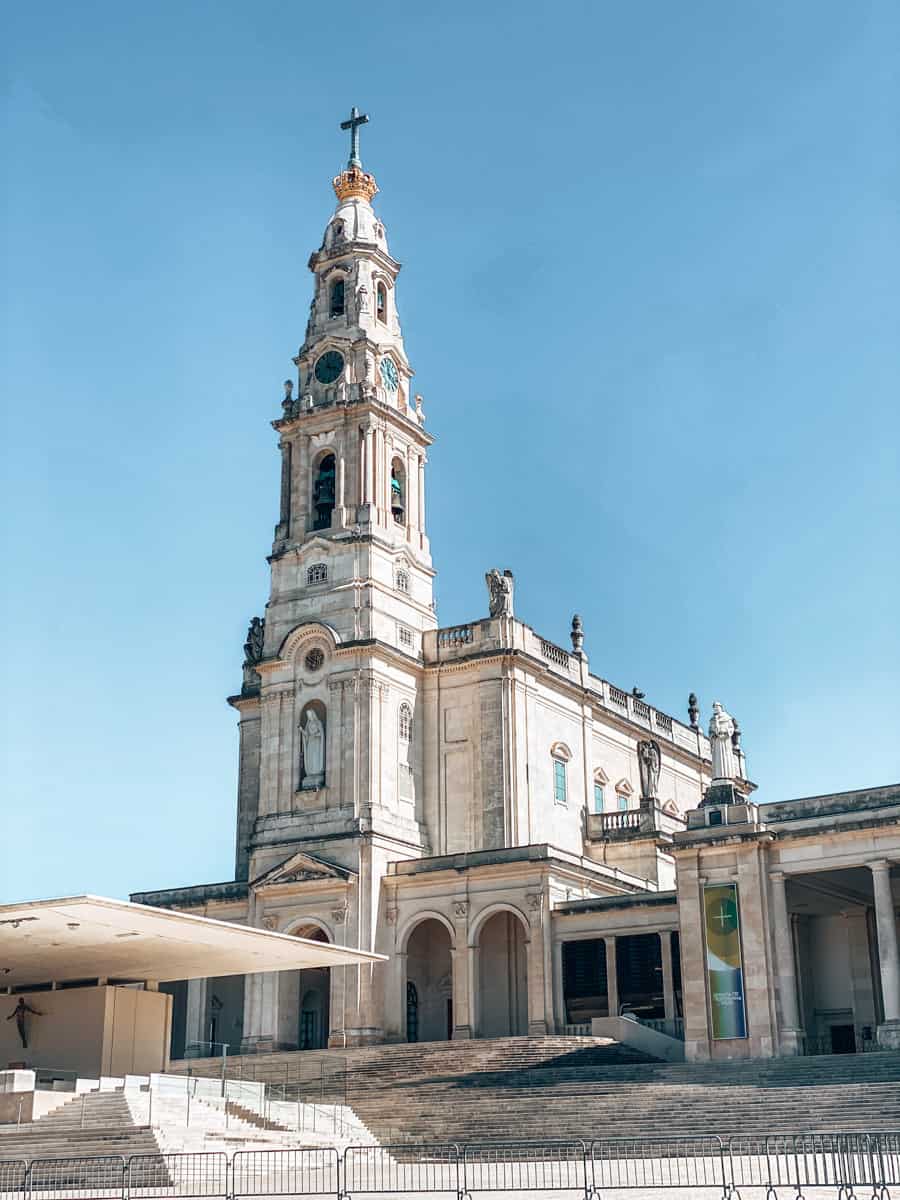
The Basílica de Nossa Senhora do Rosário, or Basilica of Our Lady of the Rosary of Fátima, is the main church at the Sanctuary. The Chapel of the Apparitions is located to the left. Basílica de Nossa Senhora do Rosário has a 65-metre-tall tower with a huge golden crown on top.


It also houses the tombs of cousins Francisco and Jacinta Marto and Sister Lucia dos Santos, including a painting of Our Lady. The fifteen mysteries of the Rosary can be seen on the fifteen altars that are displayed.
Basilica of the Most Holy Trinity
The Basílica of the Holy Trinity (Basílica da Santíssima Trindade in Portuguese) is the latest addition to the Sanctuary, built in 1996. The Basilica of the Most Holy Trinity Church has much more space for pilgrims, with 8,633 seats available. There are two sections with benches, and several chapels are inside.


These include the Chapel of the Sacred Heart of Jesus, the Immaculate Heart of Mary, the Chapel of the Holy Sacrament, and many more. In 2009, the modernist design of the Basílica da Santíssima Trindade received the Outstanding Structure Award from the International Association for Bridge and Structural Engineering.
Museu do Santuário de Fátima
Remember to visit the Museum of the Shrine of Fátima, founded in 1955. It has permanent and temporary exhibitions, and you can see religious artefacts. You’ll also learn about the Shrine’s development. The fixed displays are Fátima Light and Peace and the House Museum of Aljustrel.

Where is Fátima, Portugal?
Fátima, Portugal, is located north of Lisbon, in the municipality of Ourém and the district of Santarém. The city is well connected, and you can reach Fátima from Lisbon and Porto in about 1,5 to 2 hours by car. I’ve outlined some transport options for you below.
Travel to Fátima by car
The easiest way to reach Fátima is by car. You can follow the A1 towards Porto and exit the motorway at junction 8. The centre of Fátima is just a few minutes from the main road. The A8 takes a little longer, about 2 hours. On the plus side, you can visit Óbidos, Caldas da Rainha, and Batalha on the way. From Porto, you can follow the A1 towards Lisbon, and the journey takes about 2 hours by car.
We rent our cars with DiscoverCars to get the best prices. Their websites are easy to navigate, and you can select a car rental company of your choice. For example, we tend to rent cars from Sixt, Europcar and Hertz. Click on the banner below to get the best prices.

Trains to Fátima
You can also reach the city by public transport. Take a train from Lisbon Sete Rios to the city centre of Fátima, Portugal. The journey will take around 1 hour and 45 minutes from Lisbon. From Porto, it will take 2 hours. Book tickets on the Comboios de Portugal (CP) website or schedule your trip with Omio.
Buses to Fátima
Flixbus offers a bus service between Lisbon and Fátima or Porto to Fátima. It’s also great to visit Fátima, between the two largest Portuguese cities, as it provides a stopover halfway through your journey. The trip from Lisbon or Porto to Fátima takes just over 2 hours.
We travel regularly with Flixbus, which offers cheap transportation throughout Portugal. However, you can also book tickets online with other companies through BusBud. Alternatively, you can book bus tickets on board on certain lines.
An organised tour to Fátima
The other option to visit Fátima is with a (private) tour. Most day tours combine the trip to Fátima with other towns such as Nazaré, Óbidos, and Batalha. These tours make great day trips from Lisbon or Porto during your unforgettable time in Portugal.
Things to know before visiting Fátima, Portugal
The Sanctuary of Our Lady of the Rosary of Fátima is free to visit, and it has no opening hours. However, you can attend services, which you can check online before your visit. The Basilica of Our Lady of the Rosary of Fatima is open daily from 6 AM to 8 PM.
As you might expect, the most popular days to visit are the 13th of the month between May and October, the dates of the apparitions. Hotels are often booked well in advance.
Hotels in Fátima
There are many hotels in Fátima, as shown on the map below. But especially during important events, hotels get booked up pretty quickly. Most hotels are within walking distance from the religious sights.
Fátima is a good place to stay if you visit the city for religious reasons, but there are also many places nearby worth visiting. This way, you can make Fátima your base from which to travel. Here are three great options:
- 📍Hotel Anjo de Portugal: Hotel Anjo de Portugal is a design hotel around the corner from the Sanctuary of Our Lady of Fátima. The rooms have air conditioning, a bath, and a parking place.
- 📍Hotel Santa Isabel: Hotel Santa Isabel is 120 metres from the Sanctuary, and every room has a private bathroom. You can use the air conditioning, terrace, and onsite bar.
- 📍Hotel Dom Goncalo & Spa. Hotel Dom Goncalo & Spa. This hotel is perfect for a luxury experience. It has a swimming pool, wellness centre, and fitness centre.
Other places in the area
A visit to Fátima is often combined with visits to other towns. For example, you can visit cities like Óbidos, Nazaré, Alcobaça, Buddha Eden, Batalha, and Tomar. Região Centro, or Central Portugal, has stunning beaches and nature reserves. Coimbra, Castelo Branco, and Leiria are also in this region.

Not sure where to go in Portugal?
Take the free Portugal travel quiz and find the destination that best matches your travel style. You’ll get your result plus practical tips to help you start planning your trip.
FAQ
What is the story behind Fátima?
The story of Fátima is about the apparitions of the Virgin Mary to three shepherd children in 1917. She delivered messages urging prayer, repentance, and devotion, revealing three secrets about faith, war, and the Church. The Lady of Fátima appeared on six occasions, and ever since, Fátima has been a renowned pilgrimage site.
What is special about Fátima in Portugal?
Fátima is special for being a prominent Roman Catholic pilgrimage site where the Virgin Mary is believed to have appeared to three shepherd children in 1917. It’s known for its Sanctuary of Fátima, the Chapel of Apparitions, and its spiritual significance. Millions of visitors come to Fátima each year.
Is Fátima in Portugal worth visiting?
Yes, Fátima, Portugal, is worth visiting, especially for people interested in history, spirituality, or culture. The Fátima pilgrimage site contains the Sanctuary of Fátima, chapels, and a museum.
Why do people crawl at Fátima?
People crawl at Fátima as an act of devotion, penance, or gratitude for answered prayers. Crawling symbolizes humility and sacrifice, often as a way to honour the Virgin Mary or fulfil a personal promise.
What are the 3 secrets of Our Lady of Fátima?
The first secret was a vision of hell. The second secret concerned the end of the First World War and the start of World War II. It was seen as a warning about World War II and the spread of communism if people didn’t turn to God. The third secret was about an assassination attempt on the pope: A vision of a “bishop in white” being attacked, later linked to the 1981 assassination attempt on Pope John Paul II.
Why is the town in Portugal called Fátima?
Fátima, Portugal, is named after a Moorish princess called Fátima, who converted to Christianity after being captured by a Portuguese knight during the Reconquista. Her story symbolizes blending cultures and faiths in the region’s history.
Conclusion
Millions of pilgrims come to Fátima each year, and a visit to the pilgrimage is well worth it, even if you’re not religious. The 13th of May was the day of the first apparition, and you can expect large crowds. October 13th was the day of the last apparition, which can also be busy.
You can visit the Santuário de Fátima by yourself, but to understand the history of the Lady of Fátima, the three children, and the apparitions, it’s interesting to join a tour with a knowledgeable guide.
The city is easy to reach from both Lisbon and Porto, and there are many other nearby places to visit in Central Portugal. This place will bring another dimension to your visit if you are religious. Make sure to attend a service, light a candle and discover the magic of Fátima.

Other beautiful cities and sights north of Lisbon:
- 10 amazing tips for what to do in Óbidos Portugal
- 12 Things to do in Nazaré Portugal: Our favourite spots
- Watch the Nazaré big waves in Portugal; Things to know before you go!
- Buddha Eden; The largest, most beautiful oriental garden in Europe
- Discover the stunning Mafra National Palace
- Lisbon to Ericeira: A local guide to Portugal’s favourite surf town
- 10 Things to do in Caldas da Rainha
- 15 things to do in Tomar
- Visiting Fátima, Portugal: What you need to know
- Visit or stay at Aldeia da Mata Pequena in Portugal’s stunning countryside
- Stunning nature at Berlengas, Portugal + 8 things to do
- Celebrate the amazing Carnaval Torres Vedras in Portugal
Pin to read later!


